
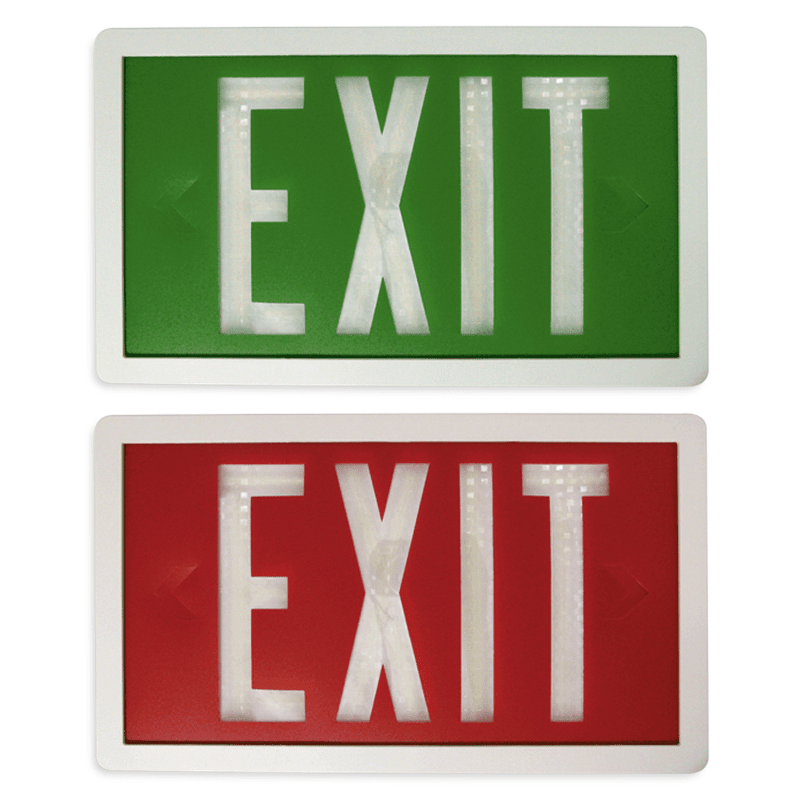

Why Exit Sign Selection Matters
Exit signs are life-safety devices — they must be reliable, code-compliant, and appropriate for your facility type. With three primary technologies on the market (tritium, LED, and battery backup), the right choice depends on your building's power infrastructure, maintenance capacity, and local fire code requirements.
Tritium Exit Signs
Tritium exit signs use a radioactive gas (tritium) to produce a constant, self-luminous glow — no electricity or batteries required.
Pros:
- Zero electricity consumption — no wiring required
- No batteries to replace
- Rated lifespan of 10–20 years
- Ideal for remote locations, hazardous environments, or facilities with unreliable power
Cons:
- Regulated by the NRC — require proper disposal at end of life
- Higher upfront cost
- Dimmer than LED alternatives
Browse our Tritium Exit Signs collection, and when it's time to retire old units, we also offer a Tritium Exit Sign Recycling & Disposal program.
LED Exit Signs
LED exit signs are the most common choice for new construction and retrofits. They use ultra-low-power LEDs and typically include a built-in battery backup to maintain illumination during a power outage.
Pros:
- Very low energy consumption (often under 5 watts)
- Long LED lifespan (50,000+ hours)
- Bright, highly visible illumination
- Available in single-face, double-face, and combo configurations
- Meets OSHA and IBC/IFC code requirements
Cons:
- Requires AC wiring
- Battery backup units need periodic battery testing and replacement (typically every 3–5 years)
Shop our full selection of LED Exit Signs & Emergency Exit Combo Signs, including combo units that pair exit signage with emergency lighting in a single fixture.
Battery Backup Exit Signs
Battery backup exit signs (also called self-contained emergency exit signs) are a subset of LED exit signs that include an integrated rechargeable battery. They remain illuminated for a minimum of 90 minutes during a power failure — as required by NFPA 101 and most local fire codes.
Key considerations:
- Battery testing is required annually under NFPA 101 (30-second test) and every 3 years (90-minute full discharge test)
- Nickel-cadmium (NiCd) batteries are most common; lithium options offer longer service life
- Some jurisdictions require a central inverter system instead of individual battery backup units — check with your local AHJ (Authority Having Jurisdiction)
Quick Comparison: Which Exit Sign Is Right for You?
| Feature | Tritium | LED + Battery Backup |
|---|---|---|
| Power Required | None | AC wiring required |
| Energy Cost | $0/year | ~$1–3/year |
| Maintenance | None (until disposal) | Battery testing & replacement |
| Lifespan | 10–20 years | 10+ years (LED); 3–5 yr battery |
| Disposal | NRC-regulated | Standard e-waste |
| Best For | Remote/hazardous locations | Most commercial buildings |
| Upfront Cost | Higher | Lower to moderate |
Code Compliance Notes
Exit sign requirements are governed by NFPA 101 (Life Safety Code), OSHA 1910.37, and local building/fire codes. Key requirements include:
- Exit signs must be illuminated at all times the building is occupied
- Minimum face illumination of 5 foot-candles at the face
- Battery backup must sustain illumination for at least 90 minutes
- Tritium signs must be registered with the NRC and disposed of through an approved program
When in doubt, consult your local Authority Having Jurisdiction (AHJ) or fire marshal before purchasing.
Need Help Choosing?
With 40 years of combined experience in commercial and industrial lighting, our team at Green Lighting Wholesale can help you select the right exit sign for your facility — whether you're outfitting a single suite or a multi-building campus. Contact us for a free consultation or to request a lighting audit.