
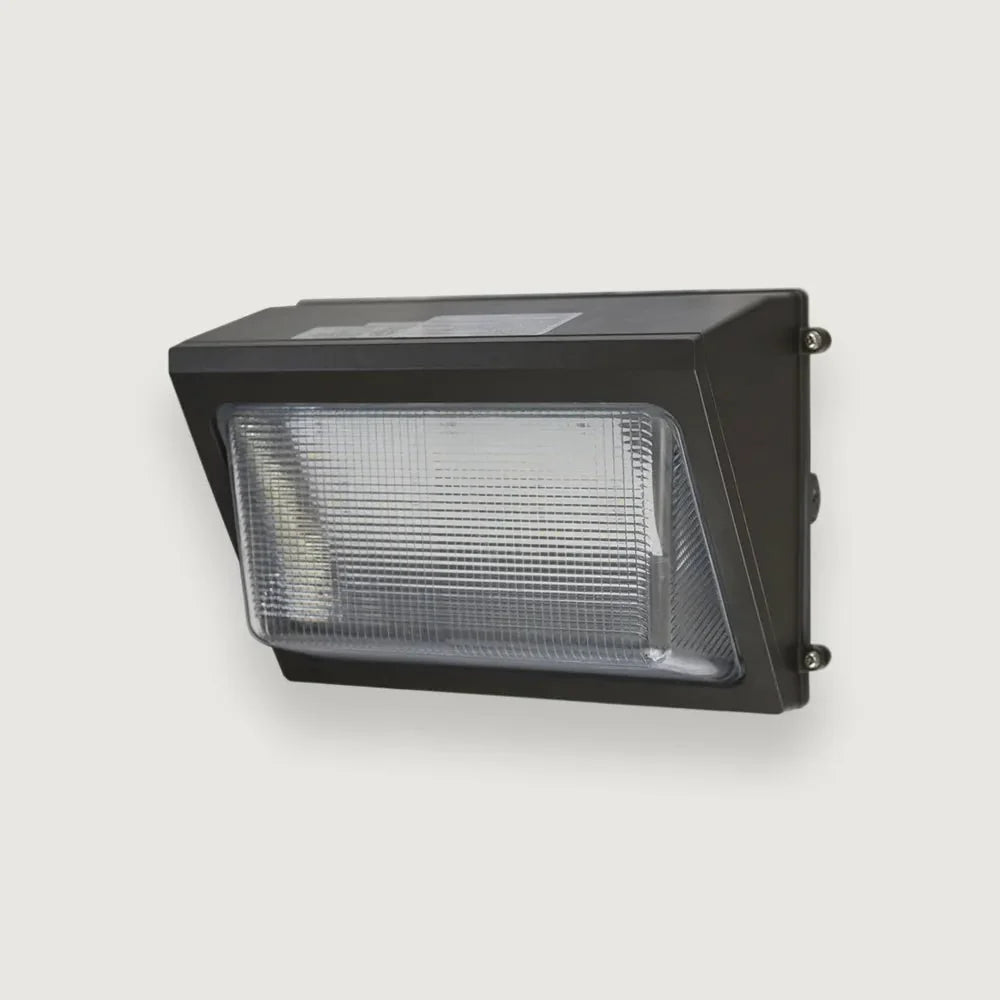
Commercial LED wall pack lights provide exterior illumination around warehouses, offices, schools, retail buildings, apartments, churches, loading docks, walkways, and other commercial properties. Choosing the correct wall pack improves nighttime visibility and security while controlling glare, energy use, and light trespass.
The best fixture is not necessarily the one with the highest wattage. Fixture style, lumen output, mounting height, distribution, voltage, controls, and local lighting requirements all affect the final result.
What Is an LED Wall Pack Light?
An LED wall pack is an outdoor light fixture mounted to the exterior wall of a building. It directs light around entrances, walkways, loading areas, parking spaces, service areas, and building perimeters.
LED wall packs commonly replace older metal-halide, high-pressure-sodium, and fluorescent exterior fixtures. Compared with many traditional light sources, LED fixtures can provide:
-
Lower energy consumption
-
Reduced maintenance
-
Longer operating life
-
Instant-on performance
-
Better light distribution
-
Improved color quality and visibility
-
Photocell and motion-sensor compatibility
-
Dimming and selectable-output options
Common Types of LED Wall Packs
Wall packs are available in several designs. The correct style depends on how much forward light is needed and how tightly the light must be controlled.
Traditional Wall Packs
Traditional wall packs generally provide broad forward and downward illumination. They are frequently used around warehouses, loading docks, service areas, and commercial building perimeters.
This style can provide substantial coverage, but its higher-angle light may not be appropriate where glare or light trespass must be minimized.
Full-Cutoff Wall Packs
Full-cutoff wall packs direct light downward and minimize illumination above the fixture. They are a good choice for walkways, entrances, property lines, and locations with dark-sky or light-trespass requirements.
Because the light is tightly controlled, fixture spacing and mounting height are especially important.
Semi-Cutoff Wall Packs
Semi-cutoff fixtures provide more forward light than full-cutoff models while offering greater control than many traditional wall packs. They can work well where broad illumination is needed without excessive uplight.
Adjustable and Rotatable Wall Packs
Adjustable wall packs allow the installer to change the fixture angle or light direction. These fixtures are useful for unusual mounting positions, signs, architectural features, loading areas, and applications requiring more precise aiming.
Mini Wall Packs
Mini wall packs are designed for smaller areas such as doorways, walkways, patios, utility entrances, and residential-style commercial properties. They typically produce less light than full-size commercial wall packs.
How Many Lumens Does a Wall Pack Need?
Lumens measure light output, while wattage measures energy consumption. Compare fixtures by lumen output and distribution instead of wattage alone.
A small entrance may need only a compact, lower-output fixture. A warehouse perimeter or loading dock may require a larger fixture with substantially more light.
Consider:
-
Mounting height
-
Distance between fixtures
-
Size of the coverage area
-
Required foot-candle levels
-
Building and pavement reflectance
-
Nearby roads, windows, and property lines
-
Desired uniformity
-
Existing ambient lighting
-
Local lighting ordinances
For larger facilities or projects with specific light-level requirements, a photometric lighting layout can help determine fixture wattage, quantity, spacing, and expected illumination.
Choosing a Wall Pack by Mounting Height
Mounting height affects coverage and brightness at ground level.
General considerations include:
-
8–12 feet: Entrances, walkways, smaller buildings, and pedestrian areas
-
12–20 feet: Commercial perimeters, loading areas, warehouses, and parking areas
-
Above 20 feet: High-output applications requiring careful fixture selection and photometric planning
These are general guidelines. Optics, lumen output, spacing, and site conditions can change the appropriate selection.
Replacing Metal-Halide Wall Packs With LED
LED wall packs commonly replace older metal-halide fixtures. General starting points may include:
| Existing Metal-Halide Fixture | Typical LED Starting Range |
|---|---|
| 70W–100W metal halide | 20W–40W LED |
| 150W metal halide | 40W–60W LED |
| 250W metal halide | 60W–100W LED |
| 400W metal halide | 100W–150W LED |
These ranges are only starting points. Always compare lumen output, distribution, mounting height, spacing, and required light levels before selecting a replacement.
Should You Choose 4000K or 5000K?
Color temperature affects the appearance of the light:
-
3000K: Warm white with a softer appearance
-
4000K: Neutral white commonly used around commercial buildings
-
5000K: Cooler, daylight-like white that can provide a brighter visual appearance
Many commercial properties choose 4000K for clear visibility without an overly cool appearance. Some security and industrial applications use 5000K. Local codes or owner preferences may limit the acceptable color temperature.
Color-selectable wall packs allow installers to choose the color temperature during installation.
Wattage-Selectable Wall Packs
Wattage-selectable fixtures can operate at multiple output levels. One fixture may replace several fixed-wattage models, making it easier to adjust brightness during installation.
Selectable fixtures are especially useful when:
-
Existing fixture wattage is uncertain
-
Several mounting heights are used
-
Light levels must be adjusted after installation
-
A facility wants to standardize replacement inventory
The selected wattage should be documented for future maintenance.
Photocells and Motion Sensors
A photocell automatically turns a wall pack on at dusk and off at dawn. Some fixtures include an integrated photocell, while others accept an optional button-style or twist-lock control.
Motion sensors can keep the fixture at a reduced output and increase brightness when activity is detected. This can reduce energy consumption in intermittently occupied areas.
Before ordering, confirm:
-
Fixture voltage
-
Photocell or sensor compatibility
-
Dimming requirements
-
Mounting height
-
Detection range
-
Desired operating schedule
Voltage and Electrical Requirements
Many commercial wall packs operate on universal 120–277V input. Some projects require 347V or 480V fixtures.
Verify the building voltage before ordering. Installation should be completed by a qualified electrician in accordance with the fixture instructions and applicable electrical codes.
Wet-Location Ratings and Durability
Exterior wall packs should carry the appropriate environmental rating for the installation. Check the individual product specifications for wet-location suitability, ingress protection, operating temperature, surge protection, and housing construction.
Coastal, industrial, high-temperature, and corrosive environments may require fixtures designed specifically for those conditions.
Reducing Glare and Light Trespass
More light is not always better. Poorly selected or aimed fixtures can create glare, illuminate neighboring properties, and waste energy.
To improve lighting quality:
-
Use full-cutoff fixtures near property lines
-
Avoid unnecessary lumen output
-
Select the correct mounting height
-
Space fixtures for uniform coverage
-
Use shielding where necessary
-
Choose appropriate optics and distribution
-
Follow local dark-sky and exterior-lighting requirements
When Is a Flood Light Better Than a Wall Pack?
A wall pack is normally mounted directly to a building and lights the surrounding ground or perimeter. A flood light is usually adjustable and can be aimed toward a sign, facade, yard, landscape, or specific target.
Use a wall pack for general building-perimeter lighting. Consider an LED flood light when adjustable aiming is required.
For parking lots and large open spaces, an LED area light may provide better pole-mounted coverage.
Shop Commercial LED Wall Pack Lights
Green Lighting Wholesale supplies wall pack lights for contractors, electricians, facility managers, property managers, schools, churches, government agencies, warehouses, and commercial property owners.
Browse our LED wall pack collection for traditional, full-cutoff, adjustable, selectable, photocell-equipped, high-voltage, and emergency-backup options.
Need help selecting a replacement? Call 614-452-5311 or email Info@greenlightingwholesale.com with the existing fixture wattage, voltage, mounting height, spacing, application, and photographs of the current fixture.
Frequently Asked Questions
What wattage LED wall pack should replace a 400W metal-halide fixture?
An LED wall pack in approximately the 100W–150W range may be a starting point, but the correct replacement depends on lumen output, distribution, mounting height, spacing, and required light levels.
What is the difference between full-cutoff and traditional wall packs?
A full-cutoff wall pack directs light downward and minimizes uplight. A traditional wall pack generally produces more forward and higher-angle illumination.
Can LED wall packs operate from dusk to dawn?
Yes. Many models include or accept a photocell that automatically turns the fixture on at dusk and off at dawn.
Are LED wall packs dimmable?
Many commercial models support 0–10V dimming, although capability varies. Confirm the specifications of the individual fixture.
Can an LED wall pack replace an existing metal-halide wall pack?
Yes. LED wall packs are commonly used as replacements, but selection should be based on lumen output and application requirements rather than wattage alone.
Are LED wall packs suitable for wet locations?
Many models are wet-location rated, but ratings vary. Always verify the product specifications before installation.
Are LED wall packs eligible for utility rebates?
Some DLC-listed wall packs may qualify for utility rebates. Eligibility depends on the specific fixture and local utility-program requirements.